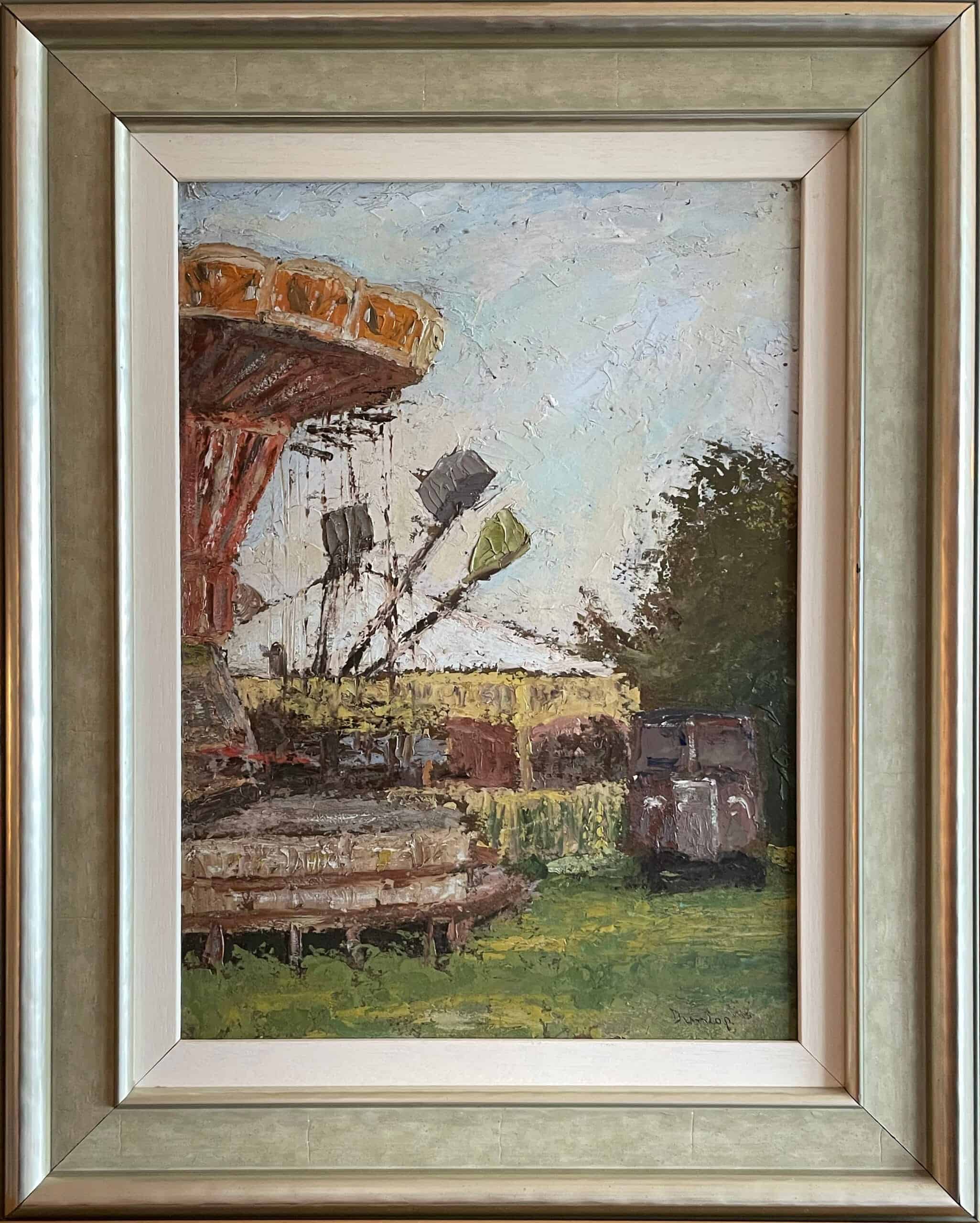
Ronald Ossory Dunlop, RA, NEA, ARA, RBA
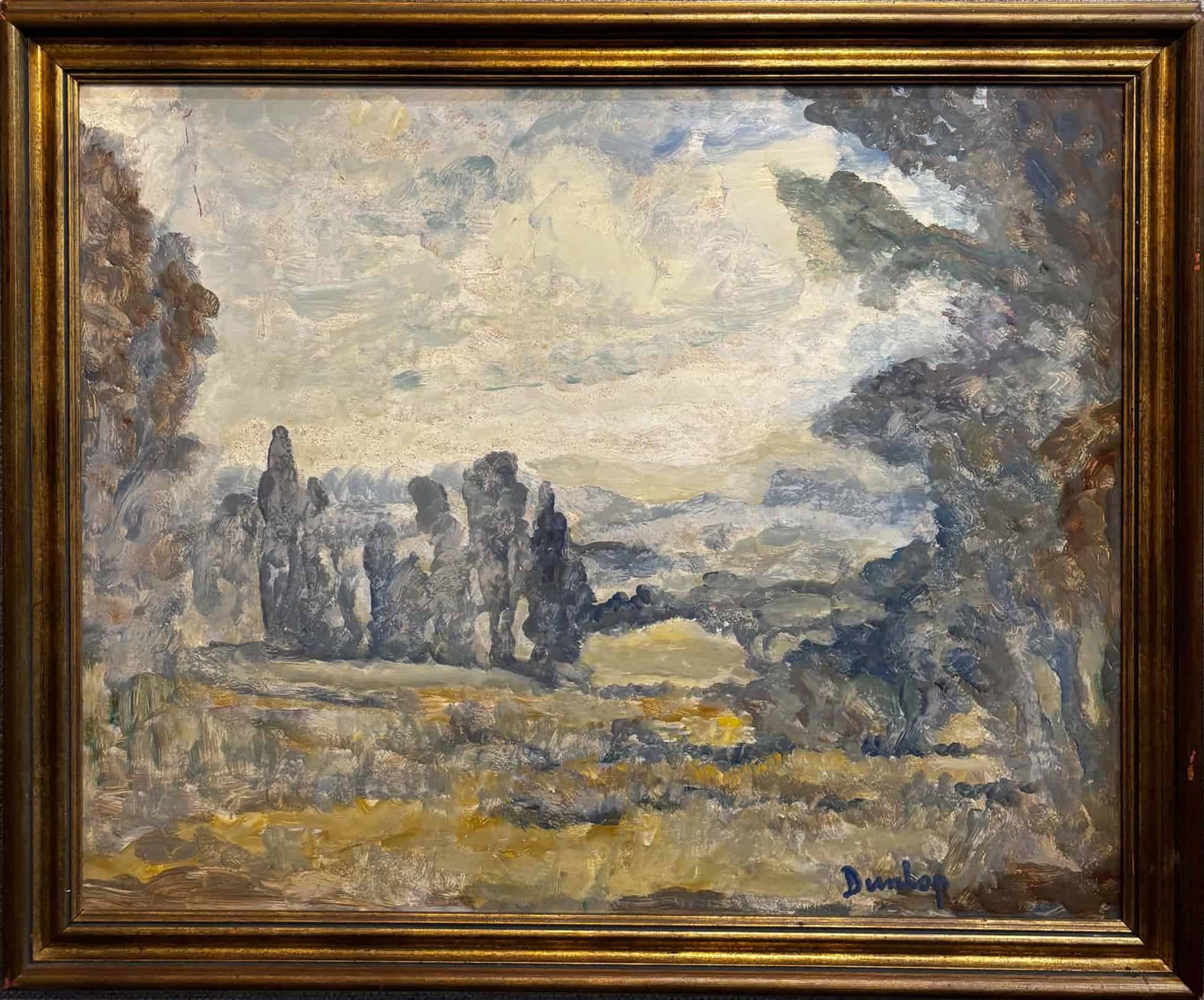
Landscape with Poplars

Irish 1894 – 1973
Ronald Ossory Dunlop was an Irish painter and writer, born in 1894, into an artistic family in 1894. His mother Eleanor was the watercolourist and theosophist and his father Daniel Nicol Dunlop was also an artist, and great friend of W. B. Yeats, James Stephens and George Russell. Yeats, Russell (Æ), and Daniel Nicol Dunlop had together published The Irish Theosophist from the home of Eleanor’s father, the Shakespearean scholar R. H. Fitzpatrick. Thus, Dunlop grew up surrounded by the seminal figures of the Irish Literary Renaissance, in an atmosphere of mysticism and Spiritualism. The Dunlop family moved to New York in 1899, then London three years later. From here, they made the annual pilgrimage back to Dublin during Horse Show week, with Dunlop’s father returning to London with two or three more ‘Æ’ canvasses each time.
Dunlop studied at Manchester School of Art, at Wimbledon College of Art and in Paris, having spent some time working in an advertising agency. He became a prolific exhibitor, venues of which included the Royal Academy and the New English Art Club. In 1916 he was granted exemption from military service as a conscientious objector, and worked on the land in the General Service section of the Friends’ Ambulance Unit.
In 1923, Dunlop founded the Emotionist Group, a somewhat obscure society comprised of writers, artists and musicians. Members of the group included Dame Peggy Ashcroft, who was a poetry writer, before she became a famous stage actress, Jean Shepeard — Dunlop’s lover — Clifford Hooper Rowe, who went on to help establish the Artists’ International Association, and a young Victor Burr, an acolyte of Dunlop. Occasional visitors included George Bernard Shaw, Sybil Thorndike and Aldous Huxley. The artists and poets met and exhibited their work at the Hurricane Lamp Gallery located on Cheyne Walk, Chelsea, around 1928. In the same year, the group published its own journal with the eponymous title Emotionism, of which only two editions are known to exist. In it, Dunlop supplied a rather vague manifesto for the Emotionism Group (“Art is the expression of the essence of life”), a poem, and an illustration of one of his paintings, The Fish Market, which is characterised by Dunlop’s unique painterly exuberance.
Dunlop held his first one-man show at the Redfern Gallery in Cork Street, London, in 1928. He began showing with the New English Art Club and later with the Royal Academy and the Royal Society of British Artists, and joined The London Group of artists in 1931. He maintained his Irish connections, returning periodically to paint in Dublin and submitting a number of works to the RHA in the 1940s and 1950s.
Most of his life was spent in England, latterly at Barnham, West Sussex, close to Chichester. He achieved fame in his lifetime, as a prolific exhibitor, at venues such as the Royal Academy, the New English Art Club, Leicester and Redfern Galleries, the Royal Society of Arts, the Royal Hibernian Academy and the Royal Glasgow Institute of the Fine Arts. Dunlop was also elected a full member of the Royal Academy in 1950.
Dunlop’s paintings can be seen in a number of public galleries, including the Tate Britain and Modern, London, the Crawford Gallery in Cork, at Cheltenham Art Gallery & Museum and the National Portrait Gallery, London. On of his works was featured on an episode of Antiques Roadshow in 2013.
In addition to painting, Dunlop was a prolific author; his books include:
Modern Still Life Painting in Oil (London, 1938)
Understanding Pictures (London, 1948)
Painting for Pleasure (London, 1951)
Sketching for Pleasure (London, 1952)
How to Paint for Pleasure (New York, 1953)
Ancient Arundel (London, 1953)
Landscape Painting: Ma Yuan to Picasso (London, 1954)
Struggling with Paint: Some Reminiscences (London, 1956, autobiography)