John Emanuel
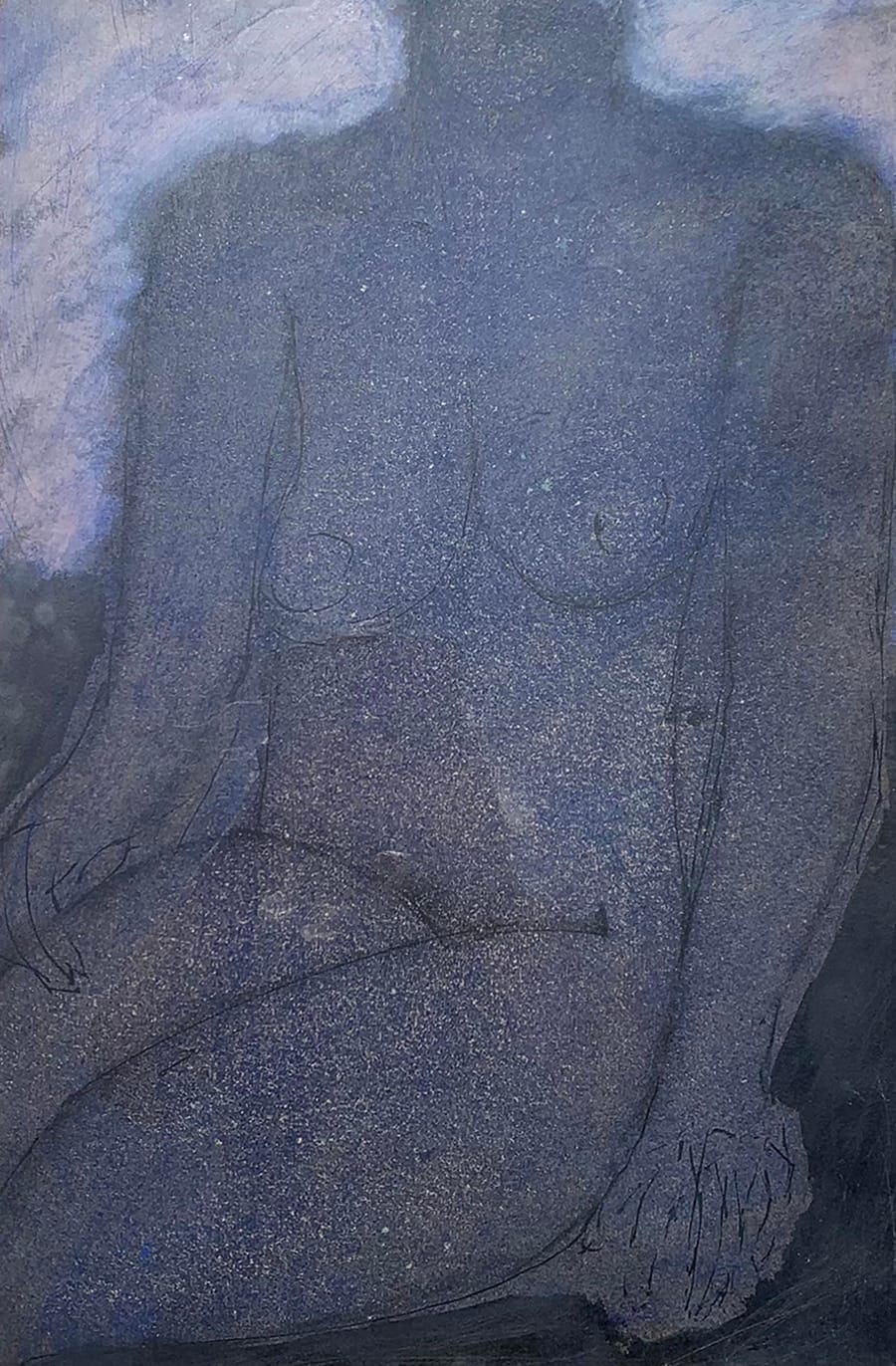
Blue Seated Nude


British 1930 – 2024
John Emanuel was born in Bury, Lancashire in 1930. With the advent of World War 2 his parents decided to move back to Barrow in Furness. He was immediately evacuated to a farm on Shap Fell. After leaving school he served an apprenticeship in painting and decorating.
His introduction to art, in particular painting, was gained through a series of talks given by a lecturer from the Extra Mural Department of Manchester University and Harry Thrubron, Leeds University. In 1964 his interest in art deepened and he moved to Cornwall. He initially made a living signwriting to support his family while he developed his drawing and painting with the help of artist friends such as John Wells, Denis Mitchell and Alexander Mackenzie. It was ten years before he had his first exhibition. Since the early 1980s John has lived in St Ives, working from one of the famous Porthmeor Studios overlooking Porthmeor Beach which had previously been used by the sculptor John Milne.
His natural creativity, inspired by a love of his subject – the lone figure, and the figure embraced by the landscape, has developed into a consistent style. Well known for his studies of the female nude, Emanuel’s paintings in oil and mixed media often places the female form within a landscape that is simplified but recognisable; whether it is west Cornwall, the Isles of Scilly or Cumbria. This subject combines John’s love of drawing the nude, and his equally intimate association with the ancient landscape of west Cornwall. It is this interaction between the classical and sometimes sensual nude with its rugged environment that characterises his work.
Emanuel’s drawings exhibit a clear, classical form and a simplicity of line which strengthens the relationship between the contours of the figure and the contours of the land. Colour is usually restricted and stronger areas of a single colour is applied in specific bands or elements of the image. This process enhances the dramatic and sculptural effect of the painting. The notion of forms sleeping beneath the earth are a recurring theme.
Emanuel also worked in a variety of media: charcoal, gouache, oils and, mixed media and lino-prints, a method he learned from John Wells.
There is a sculptural quality to Emanuel’s work in both the drawn and painted images that evolved out of an intense physical manipulation of media as the artist worked and reworked grounds and subject relentlessly up until he completed the piece. In earlier work, Emanuel often made three-dimensional figures out of clay to experiment with compositional ideas.
In his later works, some of the characteristic heavy and often textural impasto of oil gave way to subtle glazes of oil colour. This is partly through the effect of the artist using canvas in place of board or paper mounted on board, his earlier preferred support.
Over the course of his long and successful career Emanuel showed his work in many solo and mixed exhibitions throughout the country and Europe. He regularly exhibited at the Penwith Gallery, St Ives, St Ives Printmakers Gallery, and Belgrave Gallery, St Ives, and also at the Stour Gallery, Shipston-on-Stour. His work is widely collected and he has been featured in many books, articles and other publications.