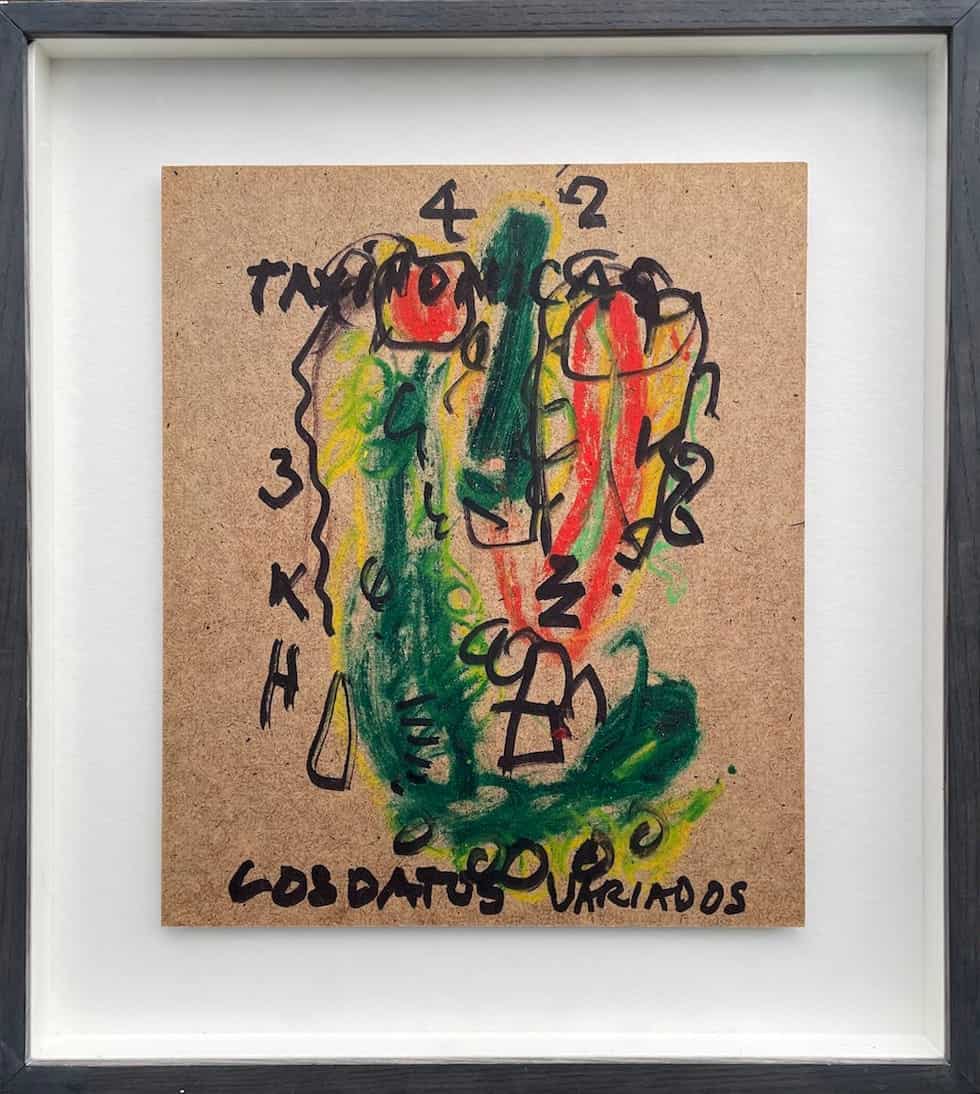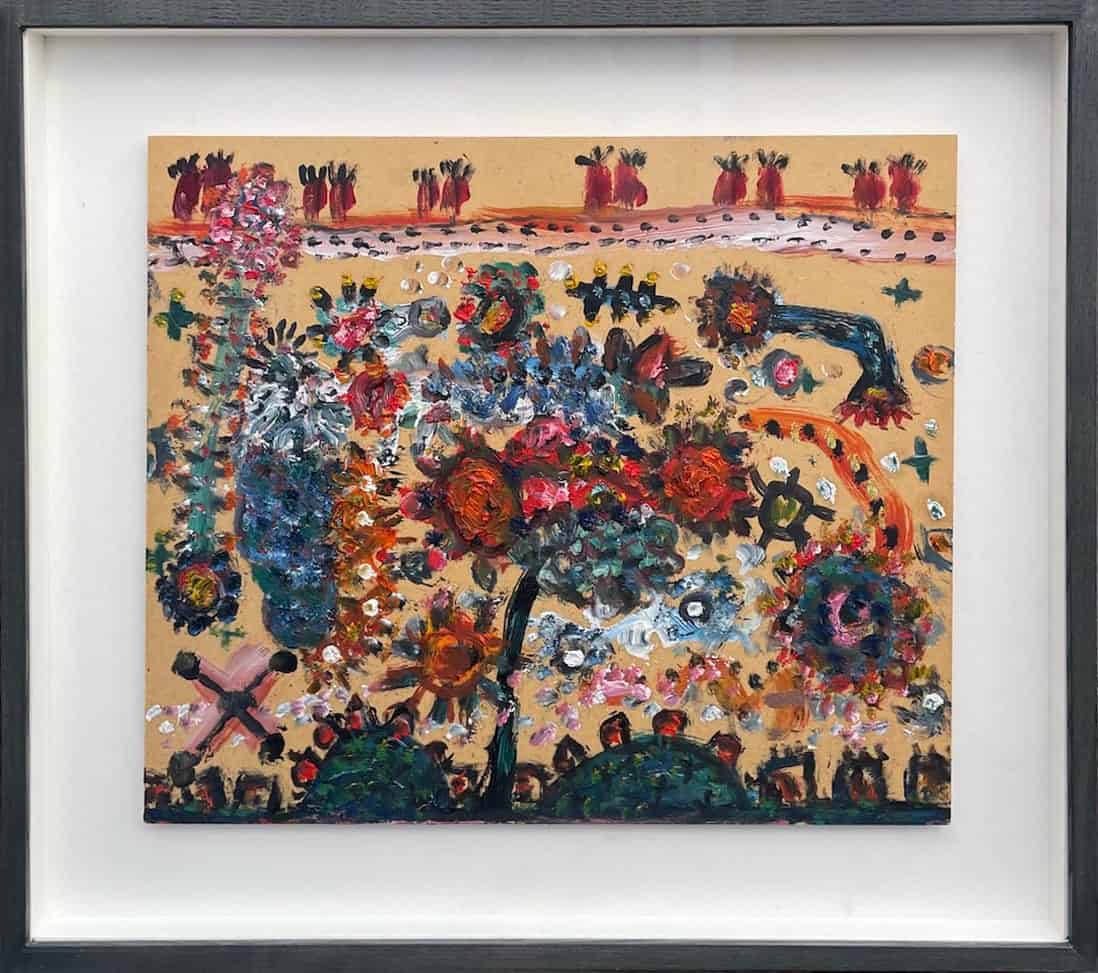
Alan Davie
Fruity Tooty

British 1932 – 2022
James Alan Davie was born in Grangemouth, Scotland in 1920, his father James William Davie, was an art teacher and painter who exhibited at the Salon des Artistes Français in 1925. Alan Davie studied at Edinburgh College of Art from 1937 to 1941. An early exhibition of his work came through the Society of Scottish Artists. Davie married Janet Gaul, a potter, artist, and designer in 1947, and together they had one child, a daughter, Jane, born in 1949.
After the Second World War, Davie played tenor saxophone in the Tommy Sampson Orchestra, which was based in Edinburgh and broadcast and toured in Europe. He also earned a living making jewellery during the postwar period. Davie travelled widely and in Venice became influenced by other painters of the period, such as Paul Klee and Joan Miró, as well as by a wide range of cultural symbols. In 1948 he saw the work of the American Abstract Expressionists like Jackson Pollock, and was impressed by their intensity and freedom. He abandoned traditional methods of composition and subject matter and sought to free his art from premeditated decision-making. This approach owes much to the artist’s interest in Zen Buddhism and his work as a jazz musician. Having read Eugen Herrigel’s book Zen in the Art of Archery (1953), he assimilated the spontaneity which Zen emphasises. The idea that the spiritual path is incompatible with planning ahead, he attempted to paint as automatically as possible.
Much like Pollock’s famous painting methods, many of Davie’s works were executed by standing above a canvas laid on the ground. He added layers of paint until sometimes the original painting had been covered over many times. Despite the speed at which he worked — he usually had several paintings on the go at once — he was adamant that his images were not pure abstraction, but all had significance as symbols. Championing the so-called ‘Primitive’, he saw the role of the artist as akin to that of the shaman, and remarked upon how disparate cultures have adopted common symbols in their visual languages.
In addition to painting, whether on canvas or paper — of which it was said was his preferred support — Davie produced several screenprints. He found a public for his work on the continent and in America some time before the British art public could reconcile itself to his mixture of ancient and newly invented symbols. In his lectures Davie stressed the importance of improvisation as his chosen method. His stance was that of an inspired soothsayer resisting the inroads of rational civilisation.
Musically, Davie also played piano, cello and bass clarinet, in addition to the tenor saxophone. In the early 1970s his interest in free improvisation led to a close association with the percussionist Tony Oxley. His paintings have also inspired music by others, notably the bassist and composer Barry Guy.
Davie designed the jacket for R.W. Feachem’s book Prehistoric Scotland, published by Batsford in 1963. The design was based upon motifs found on Pictish symbol stones.
Alan Davie died aged 93 in Hertfordshire, England in 2014.
Art collections and museums owning work by Alan Davie include the Art Institute of Chicago, Dallas Museum of Art, Fine Arts Museums of San Francisco, Metropolitan Museum of Art, Museum of Modern Art, National Galleries of Scotland, Peggy Guggenheim Collection, Tate Gallery, Art Gallery of New South Wales, Brauer Museum of Art at Valparaiso University, Fred Jones Jr. Museum of Art at the University of Oklahoma, Harvard University Art Museums, Hirshhorn Museum and Sculpture Garden, Mildred Lane Kemper Art Museum, Oklahoma City Museum of Art, The Priseman Seabrook Collection, San Diego Museum of Art, Southampton City Art Gallery, The Hepworth Wakefield and Worcester City Art Gallery & Museum.
A photographic portrait exists in both the National Portrait Gallery collection and Gimpel Fils, a modern and contemporary art gallery in Mayfair. There is also a John Bellany self-portrait featuring Davie in the National Galleries of Scotland.